
_(Messi_crop).jpg)
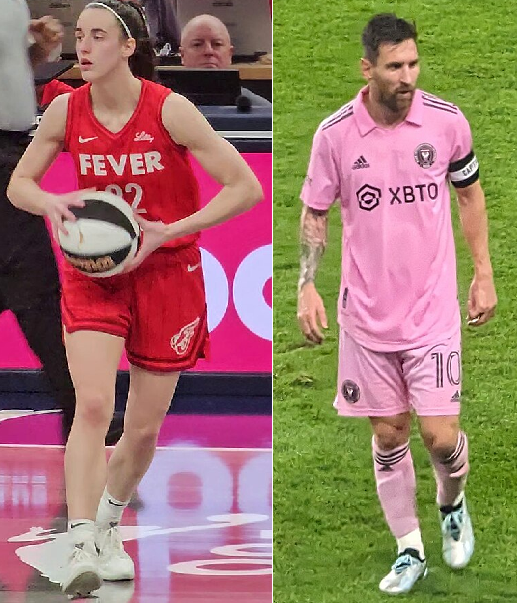
Caitlin Clark has been a bit of a headline grabber since her ascent into the upper echelons of scoring for women’s and men’s NCAA basketball. Given the amazing traction Caitlin Clark has gotten in the media and online discourse lately as her career continues through the WNBA, I was curious as to how much impact her arrival has had on the her new league as a whole.
As a comparison, I looked to another new arrival to a professional league, if one a touch shorter and with a bit more miles on his tires: Lionel Messi. He is one of the biggest names in sports worldwide, but comes to a nation that holds comparatively less enthusiasm for his sport than his other stops. There’s certainly plenty room for more excitement around soccer in America, and it’d be interesting to get an idea of the impact he might be having.
Given that the introduction of each into their respective leagues parallels a business intervention, we can apply economic time-series methodologies used to compare the pre- and post-periods to quantify how they’ve affected league interest. So I took a quick look using widely available tools to make the comparison.
Data
I looked to Google Trends to provide a quick and convenient dataset. They report time-series data on the popularity of specific search terms over time on the Google Search site. For this project, I chose to download information for the searches: “WNBA tickets” and “MLS tickets”. This was to avoid influences of other events like notable injuries or news stories that might influence broader searches like “WNBA” and capture interest that might more likely result in financial success.
Google Trends reports their search popularity values as searches in geography rescaled such that 100 represents the most searches per time period, and since data for these two searches were downloaded together, the popularity is scaled to the highest search volume seen for either of them. Measurements were provided on a weekly basis for the entire United States.
For this specific analysis, I wanted to try to look at the same time period before and after our “interventions”, Clark’s draft and Messi’s announced transfer. This did limit me a bit because of the recency of Clark’s WNBA career and both the MLS delayed 2021 season altering the typical periodicity of the resulting season and a reported methodology change in Google Trends starting in 2022. As such, we assessed the following weeks (week start listed):
- WNBA: 11/13/2022 - 06/23/2024
- MLS: 1/2/2022 - 8/6/2023
That ultimately left 74 weekly data points pre-intervention and 11 data points post-intervention. There are some handy traits that aid this comparison. The time between Messi announcing (6/7/2022) and his first match (7/21/2022) is relatively similar to the gap between the WNBA 2024 draft (4/15/2024) and Clark’s first professional game (5/14/2024).
Modeling
To conduct statistical analysis of these time-series, I employed the [CausalImpact](https://github.com/google/CausalImpact) library in R, which builds Bayesian structural time-series models (via the [bsts](https://github.com/cran/bsts) package) to predict a counterfactual time-series given a specified pre- and post-intervention period. Then it compares that to the actual observed values to obtain an estimate of causal effect, as well as the uncertainty around that estimate. After trying a few different methods, I chose a model specifying a 52 week periodicity to adjust for seasonal changes in interest and, incorporated an AR state component using AddAutoAR to capture additional trends.
To better account for draft dates in both the WNBA and MLS as possible interest spike dates, I included these in the model as indicator variables. Previewing the data, I also noted some search spikes that seemed related to interest in the 2023 MLS All-Star game vs. Arsenal, both for the announcement and the actual game played. I used an indicator for those dates in the MLS ticket model as well.
Results
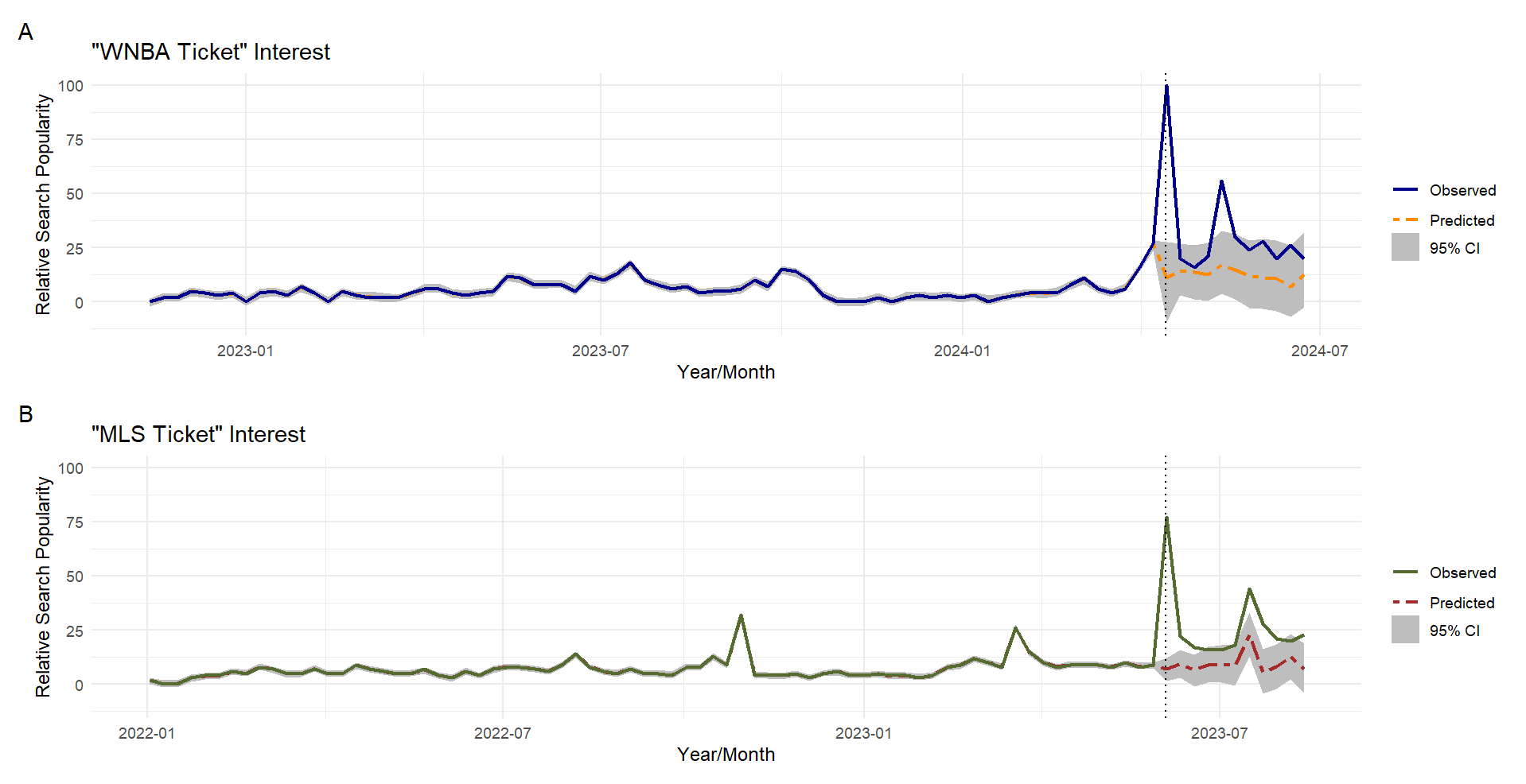
A quick glance at the data from Figure 1 makes finding an impact for both players appear quite promising. Popularity for each peak during week Clark was drafted by the Indiana Fever for the WNBA search, and when Messi announced his transfer to Miami FC for the MLS search.
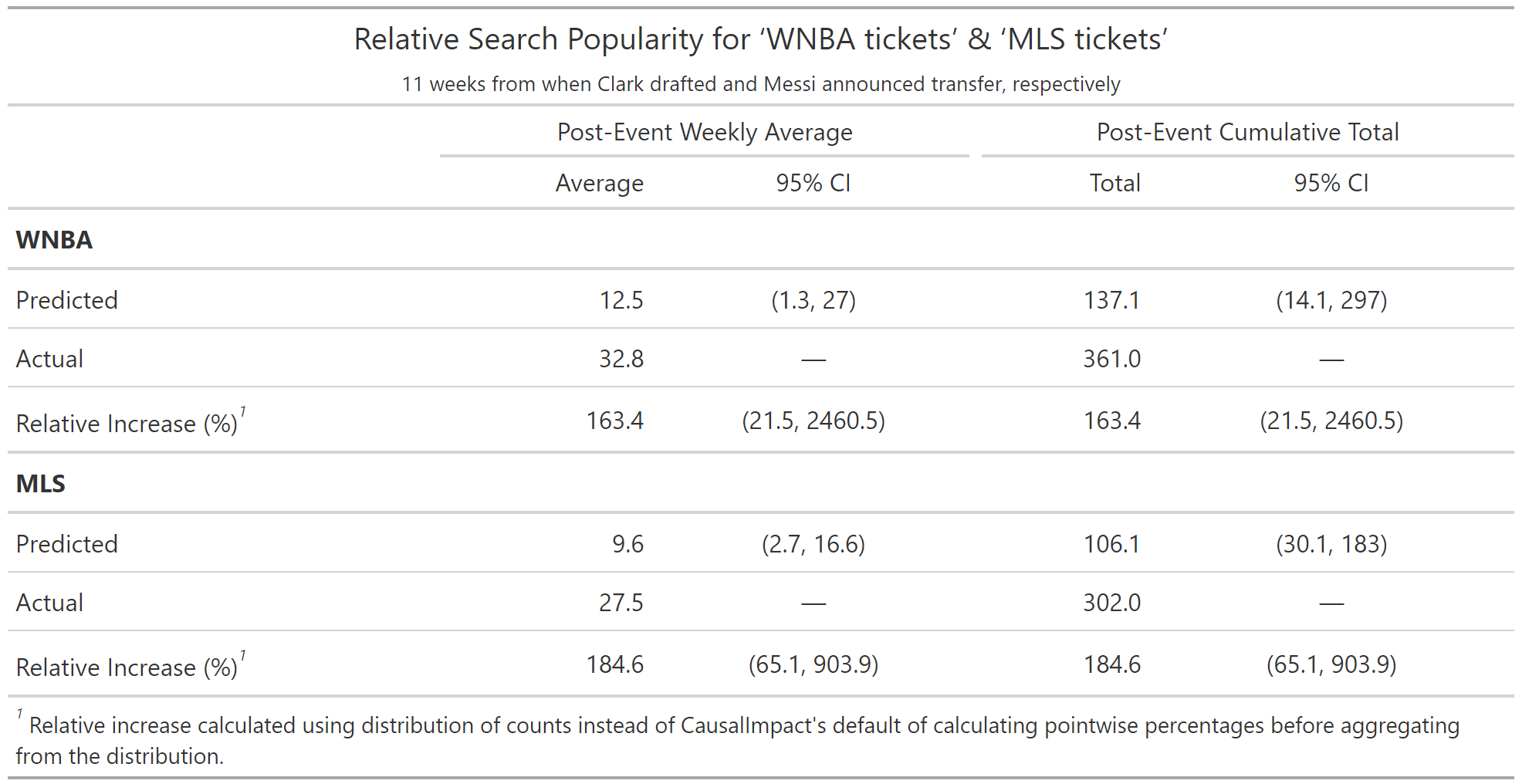
For the “WNBA tickets” search, we saw an average search value of 32.8 from draft week on, which was a good bit larger than the model using pre-draft data had predicted (12, 95% CI: 1.3, 27). Over those 11 weeks, Clark’s entry into the WNBA coincided with a total increase of 224 weekly search popularity points, 163% (95% CI: 21.5%, 2460.5%) greater than the 137.1 predicted for that time period. So even with a fairly limited number of data points, we see a convincing elevation in WNBA ticket interest (posterior probability = 99.8%).
For the “MLS tickets” search, the post-announcement period saw an average search popularity of 27.5, whereas our estimated business-as-usual model would have predicted an average of 9.6 (95% CI: 2.7, 16.6). That was an estimated 185% (95% CI: 65%, 904%) more than predicted. Given the magnitude of that change, we can be similarly confident of a Messi effect (posterior probability = 99.9%).
Closing Remarks
Both entrances into their leagues did appear to have similarly large impacts on ticket interest in their respective leagues. Given the fact that she was a relative unknown as little as three years ago, I’d rate it as nothing short of amazing.
Of course, it would be naive to attribute this all exclusively to Caitlin Clark’s presence alone. The women’s NCAA tournament (and previous season as a whole) got a great deal of attention, sparking interest in other players, and the draft night is when pretty much all of the graduating high profile players are entering the professional league. Having said that, we use Google Trends to at least get an idea of relative interest of the top draft picks. A look at draft week searches of players selected within the top 7 put Caitlin Clark at 77% of these players’ top search popularity in the last year, followed by Angel Reese (23%), Cameron Brink (19%), and Kamilla Cardoso (7%). Though other top drafted players don’t really show up, there was certainly a fair amount of interest in players other than Clark. If we make the crude assumption that Clark was responsible for that proportion of the increased interest, that still more than a 125% increase that could be assigned to her. On the other hand, while I’m not an expert on soccer players, seemingly the only recognizable big name transfer that could have spurred interest alongside Messi’s is his former and once again teammate, Sergio Busquets (July 16, 2023). But comparing searches for the two around that period, search interest for Busquets was never greater than 1/8th of Messi’s.
There are other factors worth mentioning regarding this comparison. First, ticket interest could be tied quite strongly to the area in which each athlete would be calling home. The Miami-Fort Lauderdale-West Palm Beach Metropolitan Statistical Area boasts 6,139,340 residents as the 9th largest MSA as of the last census, while the Indianapolis-Carmel-Anderson MSA clocks in with 2,111,040 residents. Also, there are only 12 WNBA teams to the MLS’ current count of 29. Even acknowledging the fact that the MLS has more than one franchise in some markets, the amount of people with the ability to travel to see a game for one versus the other would be fairly different.
On the other hand, a case could be made that our model is underestimating Clark’s impact to an extent. While Messi’s transfer was less expected considering Barcelona’s efforts to bring him back, Clark moving to the WNBA was little more than a formality after finishing her senior year at Iowa. Thus, interest in her could have generated interest in WNBA tickets even prior to the draft, perhaps evidenced by the higher search popularity in the week before the draft.
I looked into running other search terms to corroborate these observations and get a more holistic view of the impact beyond ticket sale interest, but they required additional distributional bells and whistles that the CausalImpact didn’t support as well as I had hoped. I may return to them after a deeper look into the bsts package code. Ultimately, it remains to be seen how Clark’s introduction into the WNBA affects its popularity long-term, though if WNBA All-Star votes are any indication, her impact is still going strong. Looking again at search results, the interest in MLS from Messi’s first season seems to have carried into his second to some extent, though search interest in tickets have dropped off a bit. But hopefully their feats will fuel popularity of their respective sports in this country and provide us with oohs and aahs for years to come.